LASIK vs SMILE vs FemtoLASIK in DubaiWhat’s the real difference?
LASIK and FemtoLASIK reshape the cornea under a thin flap; SMILE reshapes it through a 2–3 mm incision with no flap.
Studies show similar long-term vision results, so the right choice depends on your prescription, corneal thickness and shape, tear film, eye health and lifestyle, confirmed by a full ophthalmology assessment.
Fast answer
No option is best for everyone. SMILE avoids a flap and may cause fewer early dry-eye symptoms; LASIK and FemtoLASIK can also treat farsightedness and are easier to fine-tune later. Your eye measurements decide.
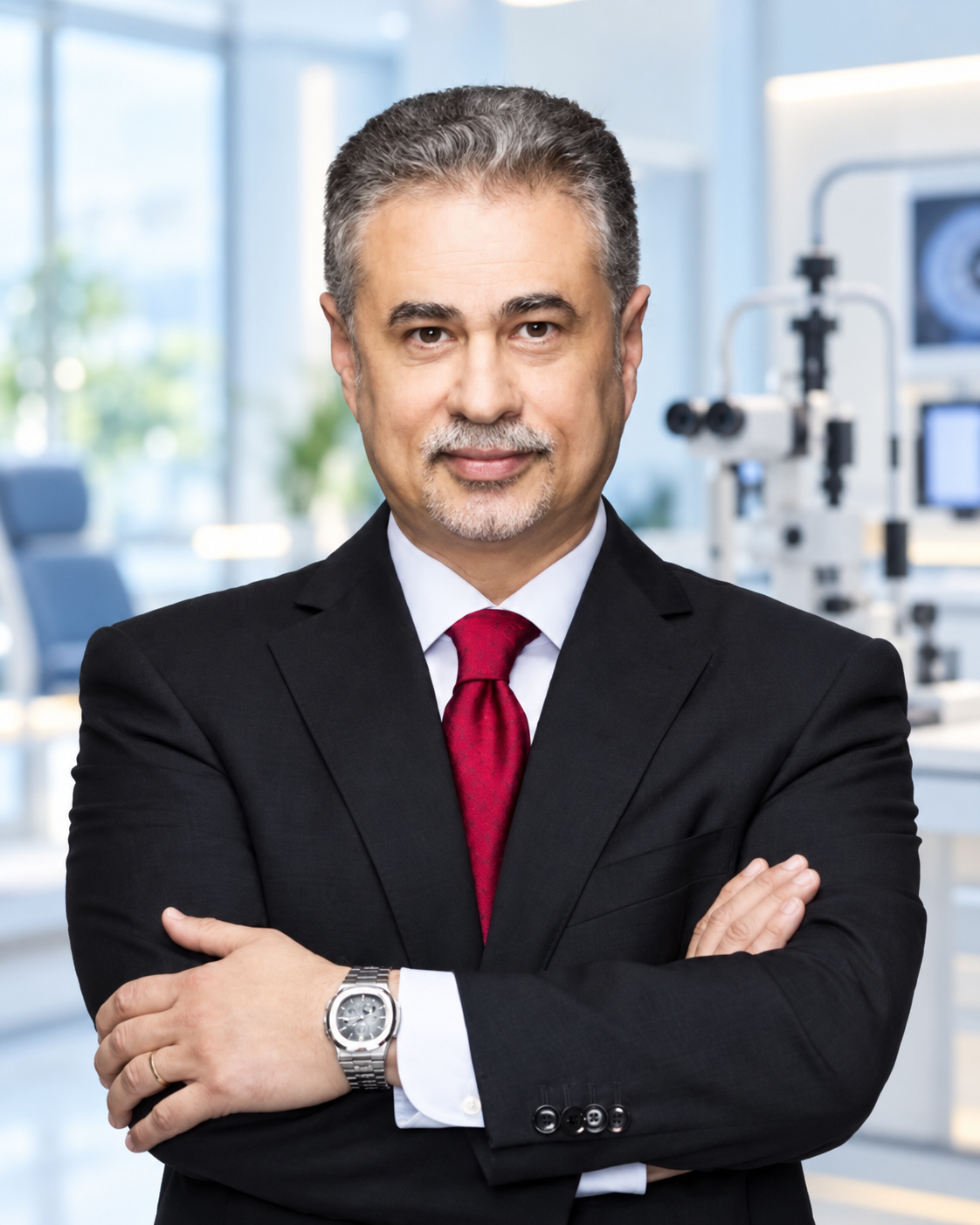
Medically reviewed by Проф. Д-р Хани Сакла, Consultant Ophthalmologist
·
Last reviewed
FФемто-ЛАСИКЛАСИК с лоскутом, созданным фемтосекундным лазером.
SУлыбкаSmall-incision lenticule removal, no LASIK-style flap.
Three names. Different surgical approaches. One decision based on clinical measurements.
01PrescriptionThe type and degree of refractive error help narrow the options.
02Corneal profileThickness, shape and regularity are central to treatment planning.
03Tear filmDry-eye and ocular-surface health should be assessed before treatment.
04Здоровье глазA complete examination determines which procedures can be considered.
60-second comparison
See the difference before reading the details
The main distinction is how the cornea is accessed and treated. Suitability still requires a complete eye examination.
LFlap-based
ЛАЗИК
A thin corneal flap is lifted, an excimer laser reshapes the cornea underneath, and the flap is laid back in place.
Flap
Yes, made by blade or laser
Treats
Myopia, hyperopia, astigmatism
Fine-tuning
Flap can usually be re-lifted
FFemtosecond flap
Фемто-ЛАСИК
LASIK in which the flap is cut by a femtosecond laser instead of a microkeratome blade, then reshaped the same way.
Flap
Yes, made by femtosecond laser
Treats
Myopia, hyperopia, astigmatism
Fine-tuning
Flap can usually be re-lifted
SSmall incision
Улыбка
A femtosecond laser shapes a thin disc of tissue (lenticule) inside the cornea, which is removed through a tiny incision.
Flap
No flap, 2–3 mm incision
Treats
Mainly myopia and myopic astigmatism
Fine-tuning
Often done as surface PRK
Direct answer
Какой метод лучше: LASIK, SMILE или FemtoLASIK?
Нет процедуры, которая была бы универсально лучше. Meta-analyses comparing SMILE and LASIK find no significant difference in long-term refractive results. The differences are in the method: LASIK and FemtoLASIK use a flap and can treat farsightedness; SMILE has no flap, a 2–3 mm incision and may cause fewer early dry-eye symptoms. The most suitable option is decided after checking your prescription, corneal thickness and shape, tear film, eye health and visual goals.
01Выбрать по диагнозуNot by popularity or procedure name.
02Сравнить методFlap-based versus small-incision approaches.
03Подтвердить пригодностьA complete ophthalmology assessment is essential.
Key takeaways
All three are laser vision correction. Each reshapes the cornea to reduce nearsightedness and astigmatism; LASIK and FemtoLASIK also treat farsightedness.
FemtoLASIK is a type of LASIK. The only difference is that a femtosecond laser, not a microkeratome blade, cuts the flap.
SMILE has no flap. A lenticule is removed through a 2–3 mm incision (EyeWiki, AAO).
Results are similar. Studies show no significant difference in long-term refractive outcomes between SMILE and LASIK.
Basic eligibility: age 18 or over and a prescription that has not changed in the past year (U.S. FDA).
The assessment decides. Corneal thickness, corneal shape and tear-film tests confirm which option, if any, is safe for you.
LASIK vs SMILE vs FemtoLASIK: comparison table
All three are forms of laser vision correction, but they are not interchangeable. The table compares how each one works, what it treats, and the practical differences patients ask about most.
LASIK vs FemtoLASIK vs SMILE: key differences
Функция
ЛАЗИК
Фемто-ЛАСИК
Улыбка
How it works
Excimer laser reshapes the cornea under a flap.
Same as LASIK; the flap is cut by a femtosecond laser.
Femtosecond laser creates a lenticule that is removed through a small incision.
Corneal flap
Да blade or laser
Да laser
No 2–3 mm incision
Treats
Myopia, hyperopia, astigmatism.
Myopia, hyperopia, astigmatism.
Mainly myopia and myopic astigmatism.
Dry eye in the first months
Temporary dry eye is common after flap-based surgery and usually improves.
A comparative study found fewer dry-eye symptoms at 6 months.
Contact sports / eye injury
A healed flap can still be displaced by a strong blow to the eye.
No flap to displace.
Fine-tuning later
The flap can usually be re-lifted for an enhancement.
Often done as a surface treatment (PRK).
Long-term results
Meta-analyses show no significant difference in refractive outcomes between SMILE and LASIK.
Who decides
Your ophthalmologist, after a complete eye examination and corneal measurements.
Swipe to compare →
What is LASIK?
LASIK (laser-assisted in situ keratomileusis) is a laser vision correction procedure for nearsightedness (myopia), farsightedness (hyperopia) and astigmatism. The surgeon creates a thin corneal flap, an excimer laser reshapes the cornea beneath it, and the flap is repositioned. According to Mayo Clinic, the surgery is usually completed in 30 minutes or less.
LASIK is not suitable for everyone. Your ophthalmologist must assess factors such as prescription stability, corneal thickness and shape, tear film and overall eye health before recommending treatment.
FemtoLASIK (femtosecond laser-assisted LASIK), sometimes called bladeless or all-laser LASIK, is LASIK in which a femtosecond laser creates the corneal flap instead of a mechanical microkeratome blade. The cornea is then reshaped with an excimer laser exactly as in LASIK.
FemtoLASIK therefore remains a flap-based procedure. Whether it is appropriate depends on the same principle as any vision correction decision: the eye measurements and clinical findings must support the procedure.
What is SMILE?
СМАЙЛ (малоинвазивная экстракция лентикулы) is a flapless procedure. A femtosecond laser shapes a thin disc of corneal tissue, called a lenticule, which the surgeon removes through a 2–3 mm incision to change the curvature of the cornea. SMILE belongs to a newer group of techniques known as keratorefractive lenticule extraction (KLEx).
In the United States, the FDA approved SMILE in 2016 for nearsightedness and in 2018 for nearsightedness with astigmatism. It is mainly used for myopia and myopic astigmatism, so it is not the usual choice for farsightedness. Suitability still depends on your prescription and corneal measurements.
The differences that actually matter
Procedure method
LASIK and FemtoLASIK involve creating a corneal flap before reshaping the cornea. SMILE uses a small incision and removes a lenticule without creating a traditional LASIK flap.
Flap creation
FemtoLASIK uses a femtosecond laser to create the flap. Traditional LASIK may use a different flap-creation method. SMILE follows a different small-incision surgical approach.
Prescription
The range and type of refractive error matter. Not every procedure is designed for every prescription.
Corneal profile
Corneal thickness, shape and regularity are central to determining whether laser vision correction is appropriate.
Tear film / dry eye
Dry-eye symptoms and eye-surface health should be assessed and, when necessary, treated before a laser vision correction recommendation.
Lifestyle
Work, screen use, sports, driving and visual goals can form part of the discussion, but they do not replace clinical suitability.
LASIK vs SMILE: which is better?
Neither LASIK nor SMILE is automatically better. Large reviews find no significant difference between them in long-term refractive results, loss of vision lines or the proportion of patients reaching 20/20. The choice comes down to the practical differences below and to what your eye measurements allow.
SMILE may suit you if
You are nearsighted (with or without astigmatism), play contact sports or work in a job with a risk of eye injury, or have borderline dry eye that your doctor has assessed. In a comparative study, 80% of SMILE patients no longer used any eye drops at 6 months, compared with 57% after LASIK (AAO).
LASIK or FemtoLASIK may suit you if
You are farsighted, need a treatment profile SMILE cannot offer, or prefer the option with the longest track record and the simplest enhancement if a small correction is needed later.
The clinically useful question is not “Which procedure is newest?” but “Which options are safe and appropriate for my eyes?”
LASIK vs FemtoLASIK: what is the difference?
The only difference is how the corneal flap is created. Traditional LASIK uses a microkeratome, a precision oscillating blade; FemtoLASIK uses a femtosecond laser, which lets the surgeon program the flap’s thickness, diameter and edge. The reshaping step is the same in both, and both remain flap-based procedures, so the final recommendation depends on your corneal measurements, eye health and surgeon assessment.
Recovery after LASIK, FemtoLASIK and SMILE
Recovery is quick for most people, but full healing takes longer than the first few days suggest. The timeline below is typical for LASIK according to Mayo Clinic; FemtoLASIK and SMILE follow a broadly similar course, and your surgeon gives you a written aftercare plan.
Same dayYou can see after surgery, but vision is not clear yet. You go home the same day and rest your eyes with the prescribed drops.
First few daysVision is generally good within a few days. Your doctor checks your eyes and confirms when you can drive and return to work.
First weeksGlare, halos or night-vision difficulty usually settle within a few days to a few weeks. Avoid eye make-up for a few weeks, and swimming or contact sports for several weeks.
2–3 monthsThe eye can take up to 2–3 months to heal completely and for vision to stabilise.
The decision process
How an ophthalmologist decides which options can be considered
The consultation is more important than the procedure name. A vision correction assessment may include prescription review, corneal measurements, eye-surface evaluation and a discussion of your visual needs.
01
Measure
Review your refractive error, prescription stability and corneal measurements.
02
Check eye health
Assess the cornea, tear film and general eye condition for factors that may affect suitability.
03
Match the option
Discuss appropriate procedures, limitations, risks, alternatives and expected recovery for your case.
Рецепт myopia, hyperopia and/or astigmatism.
Corneal thickness: whether the cornea supports the planned treatment.
Corneal shape: screening for irregularities and corneal risk factors.
Tear film: checking dry-eye and ocular-surface health.
Образ жизни: work, sports, driving and visual demands.
Expectations: understanding realistic benefits and limitations.
Who may be suitable for laser vision correction?
Suitability cannot be confirmed from a webpage. In general, an ophthalmologist will look for stable vision, appropriate corneal measurements and an eye examination that does not reveal a reason to delay or avoid laser treatment.
Your prescription is sufficiently stable for the procedure being considered.
Your corneal thickness and shape are appropriate for the planned treatment.
Significant dry-eye symptoms are evaluated and managed when necessary.
There is no active eye infection or inflammation affecting the decision.
Your ophthalmologist confirms that the expected benefits and limitations are appropriate for your case.
When laser vision correction may not be suitable
Laser vision correction is not recommended for every patient. Some findings may require treatment first, monitoring, additional testing or a different vision correction approach.
Unstable or changing prescription.
Thin, irregular or clinically unsuitable corneas.
Significant untreated dry eye or ocular-surface disease.
Active eye infection or inflammation.
Certain corneal conditions or keratoconus risk.
Expectations that do not match the likely benefits and limitations of treatment.
Being unsuitable for LASIK or SMILE does not always mean you cannot be treated. Two common alternatives may be discussed:
PRK (surface laser)
The laser treats the surface of the cornea after the thin outer layer is removed, so there is no flap and no incision. It may be considered when the cornea is thinner. Recovery is slower and the first days are more uncomfortable than after LASIK or SMILE.
ICL (implantable lens)
A thin lens is placed inside the eye, in front of the natural lens, without removing corneal tissue. It may be considered for high prescriptions or corneas that are not suitable for laser reshaping.
How much do LASIK, FemtoLASIK and SMILE cost in Dubai?
The price depends on the procedure and laser platform, whether one or both eyes are treated, the pre-operative tests needed and the follow-up included. Because the assessment decides which procedure is suitable, Ebsaar gives a personalised quote after your consultation rather than one price for everyone.
When comparing quotes in Dubai, ask what is included: the assessment and corneal scans, the surgery, medication, follow-up visits and any enhancement. Many insurance plans treat laser vision correction as elective, so check your policy before booking.
Ebsaar ophthalmologists with refractive surgery experience
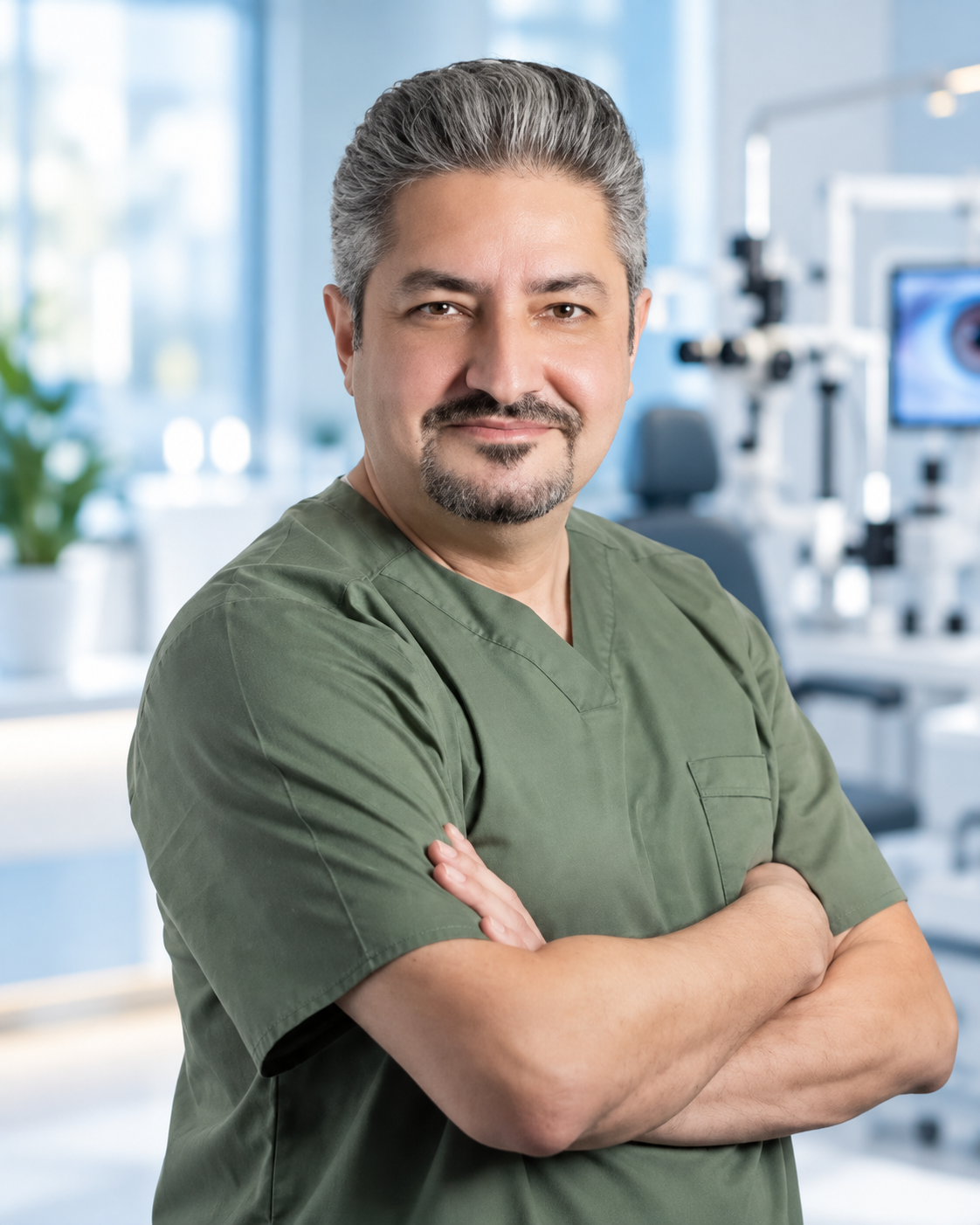
Your assessment is carried out by a consultant ophthalmologist. These Ebsaar doctors list refractive surgery among their areas of expertise:
Why compare your options at Ebsaar Eye Surgery Center?
Ebsaar Eye Surgery Center provides ophthalmology care in Dubai, including LASIK assessment, laser vision correction, cataract care, retina services, cornea treatment, glaucoma management, dry-eye care and comprehensive eye examinations. Treatment planning begins with diagnosis rather than choosing a procedure name in advance.
Assessment firstEye measurements and clinical findings come before a treatment recommendation.
Multiple vision-correction optionsLASIK, FemtoLASIK, SMILE and other options may be discussed when clinically appropriate.
Джумейра, ДубайVilla 32A, Jumeirah Beach Road, Dubai, United Arab Emirates.
Next step
Stop comparing procedure names. Start with your eye measurements.
Contact Ebsaar Eye Surgery Center in Dubai to arrange a vision correction assessment and discuss which options may be appropriate for your eyes.
These answers are intentionally concise so you can understand the main differences quickly. They do not replace an individual eye examination.
What is the difference between LASIK, SMILE and FemtoLASIK?
LASIK and FemtoLASIK reshape the cornea under a thin flap; FemtoLASIK cuts that flap with a femtosecond laser instead of a blade. SMILE has no flap: a lenticule is removed through a 2–3 mm incision.
Является ли SMILE лучше LASIK?
Not automatically. Studies show similar long-term vision results. SMILE avoids a flap and may cause fewer early dry-eye symptoms, while LASIK can also treat farsightedness and is easier to fine-tune later. Your corneal measurements and eye health decide which is better for you.
Лучше ли Фемто-ЛАСИК, чем традиционный ЛАСИК?
FemtoLASIK makes the flap with a femtosecond laser instead of a microkeratome blade, so the surgeon can program the flap’s thickness and shape. The reshaping step is the same. Whether it is preferable for you depends on your clinical findings and your surgeon’s recommendation.
Which procedure has the fastest recovery?
Recovery is similar for most people. After LASIK, vision is generally good within a few days, and SMILE and FemtoLASIK follow a broadly similar course. Full healing can take up to 2–3 months, and your ophthalmologist will give you a follow-up plan.
Is SMILE better for dry eyes?
SMILE may cause fewer dry-eye symptoms in the first months. In one comparative study, 80% of SMILE patients no longer used eye drops at 6 months, compared with 57% after LASIK. Existing dry eye still needs to be assessed and treated before any laser procedure.
Which is better if I play contact sports?
SMILE has no flap, so there is no flap that can be displaced by a blow to the eye. The U.S. FDA notes that people who regularly take blows to the face, such as in boxing or martial arts, may not be good LASIK candidates. Your ophthalmologist will weigh this with your measurements.
Can SMILE correct farsightedness?
SMILE is mainly used for nearsightedness and nearsighted astigmatism, and its FDA approval covers those uses. LASIK and FemtoLASIK can treat farsightedness in suitable patients.
Can LASIK, SMILE or FemtoLASIK correct astigmatism?
Yes, all three can treat astigmatism in suitable patients. Eligibility depends on the amount of astigmatism, your overall prescription and your corneal shape.
What is the minimum age for LASIK or SMILE?
According to the U.S. FDA, no lasers are approved for LASIK in people under 18, and your glasses or contact lens prescription should not have changed in the past year.
Does LASIK or SMILE hurt?
Numbing eye drops are used, so most people feel pressure rather than pain during the procedure. Mild irritation, watering or a gritty feeling is common for a few hours afterwards.
Will I still need reading glasses after laser eye surgery?
Possibly, later in life. LASIK, FemtoLASIK and SMILE correct your distance prescription but do not stop presbyopia, the natural loss of near focus that usually begins in your 40s.
How much does LASIK or SMILE cost in Dubai?
The cost depends on the procedure, the laser used, whether one or both eyes are treated and what follow-up is included. Ebsaar provides a personalised quote after your vision correction assessment.
How do I know which procedure I am suitable for?
You need a complete vision correction assessment. The doctor reviews your prescription, corneal thickness and shape, tear film, eye health and visual goals before recommending an option.