



Childhood Myopia Control Dubai
Myopia Control in Dubai: 7 Ways to Slow Nearsightedness in Children
Myopia control in Dubai is becoming an important topic for parents because childhood nearsightedness can progress quickly, especially when children spend long hours reading, studying, using tablets, or looking at screens. Glasses can help a child see clearly, but they do not always address how fast myopia is progressing.
This guide explains what childhood myopia is, why early diagnosis matters, what signs parents should watch for, and how modern myopia management may help slow progression and protect long-term vision.
Important: This article is for educational purposes only. A child’s myopia control plan should be decided after a comprehensive eye examination, prescription assessment, eye health check, and discussion with an ophthalmologist. Do not start eye drops, contact lenses, or any treatment without medical supervision.
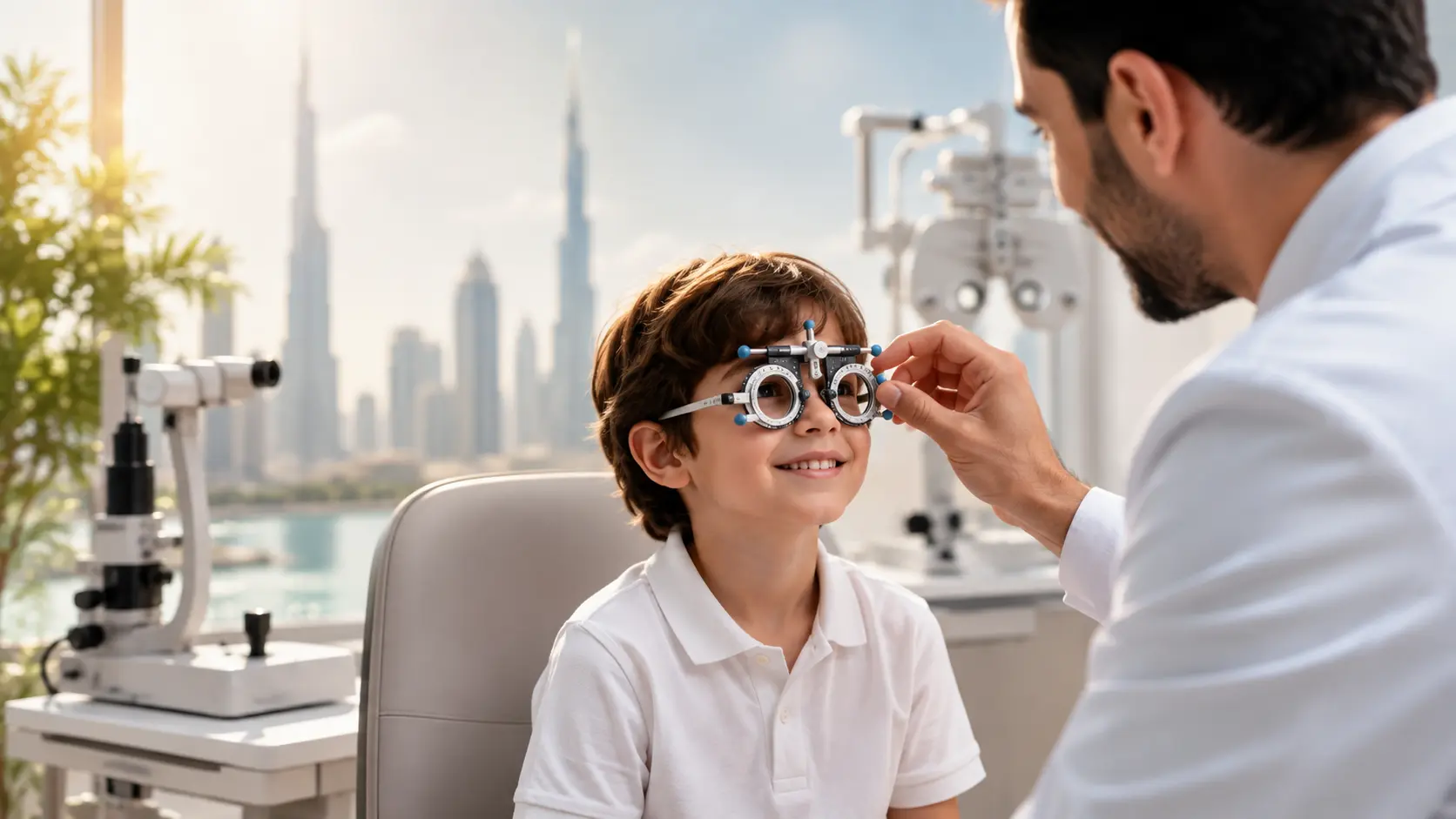
Children’s myopia control assessment and pediatric eye care at Ebsaar Eye Surgery Center in Dubai.
Quick Answer: What Is Myopia Control?
Myopia control means managing childhood nearsightedness with the goal of slowing its progression over time. Regular glasses correct blurry distance vision, but myopia control may involve monitoring prescription changes, measuring eye growth when needed, lifestyle advice, special spectacle lenses, contact lens options, or atropine drops under medical supervision. The right option depends on the child’s age, prescription, eye health, lifestyle, and risk factors.
Prof. Dr. Hani Sakla Featured on Monte Carlo Doualiya
Prof. Dr. Hani Sakla was hosted on Monte Carlo Doualiya’s “Sustainable Health” program to discuss childhood myopia, modern solutions to slow its progression, and why parents should protect children’s vision through early diagnosis and regular eye examinations.
This article builds on that important awareness message and gives parents a practical guide to myopia control in Dubai and when to book a pediatric eye assessment.
What Is Childhood Myopia?
Myopia, also called nearsightedness, means the child can usually see nearby objects more clearly than distant objects. A child with myopia may struggle to read the classroom board, watch TV from a normal distance, recognize faces from far away, or see road signs clearly.
Childhood myopia often starts during school years and may progress as the child grows. The concern is not only that the child needs stronger glasses. The bigger concern is that higher levels of myopia may increase the risk of eye problems later in life, especially when myopia becomes high.
Why Myopia Control in Dubai Matters
Myopia control in Dubai matters because children today are exposed to long study hours, digital screens, indoor lifestyles, and reduced outdoor time. These factors can contribute to visual strain and may influence the way a child’s eyes develop.
Parents often think the solution is simply changing the glasses prescription every year. In some cases, that may be enough. But when myopia is progressing quickly, the child may need a more complete plan to monitor and manage progression.
The Goal Is Not Just Clear Vision Today
The goal of myopia control is to help children see clearly now while also reducing the speed of prescription progression when suitable. Early action can make a meaningful difference because a child’s eyes may continue changing for years.
Signs Your Child May Have Myopia
Children do not always complain clearly when they cannot see well. Some children assume that blurry distance vision is normal, while others may avoid schoolwork, sports, or reading the board without explaining why.
Squinting
Your child may narrow their eyes to see the board, TV, or objects far away.
Sitting Too Close
Children with myopia may sit close to the TV, tablet, computer, or classroom board.
Headaches
Headaches can happen when the child is struggling to see clearly or forcing their eyes to focus.
School Difficulty
A child may miss information on the board, copy incorrectly, or lose interest in class activities.
Eye Rubbing
Rubbing can happen with eye strain, fatigue, dry eye, allergies, or unclear vision.
Blurry Distance Vision
Your child may complain that far objects look blurry while near tasks are easier.
Glasses vs Myopia Control: What Is the Difference?
Regular glasses correct blurry vision by helping light focus properly on the retina. They are important because children need clear vision for learning and daily life. However, regular glasses do not necessarily slow the progression of myopia.
Myopia control in Dubai takes a wider approach. It focuses on measuring the child’s current vision, checking eye health, understanding risk factors, monitoring progression, and choosing a management option when appropriate.
7 Ways to Slow Nearsightedness Progression in Children
The best approach depends on the child. There is no one-size-fits-all plan, and parents should avoid online shortcuts or unproven methods. A safe plan starts with a proper pediatric eye examination.
1. Book a Comprehensive Children’s Eye Test
The first step in myopia control in Dubai is a detailed children’s eye test. This helps confirm the prescription, check whether the child has myopia, measure how much it has changed, and rule out other eye conditions that can affect vision.
A comprehensive exam may include vision testing, refraction, eye alignment assessment, eye pressure check when needed, slit lamp examination, and retina evaluation depending on the child’s age and symptoms.
2. Track Prescription Changes Over Time
Myopia control depends on monitoring. If a child’s prescription is increasing quickly, the doctor may recommend more frequent follow-up and a stronger management plan. Parents should keep previous prescriptions because they help show the speed of progression.
3. Encourage More Outdoor Time
Outdoor time is one of the most practical lifestyle habits for children’s eye health. More time outside may help reduce the risk of developing myopia, especially in younger children, and it also supports a healthier balance between distance vision and near work.
Outdoor time should not replace medical care when a child already has progressive myopia, but it can be part of a broader plan recommended by the doctor.
4. Manage Screen Time and Near Work
Long periods of close work can increase visual fatigue. Children should take regular breaks from screens, avoid holding devices too close, use good lighting, and maintain a comfortable reading distance.
Parents should also watch for signs of eye strain such as rubbing, headaches, blinking, watery eyes, or avoiding reading.
5. Consider Myopia Management Spectacles
Some children may be suitable for special spectacle lens designs created for myopia management. These lenses are different from standard single-vision glasses because they are designed to help manage how the eye focuses light across different parts of the lens.
The doctor will decide whether this option is suitable based on the child’s age, prescription, cooperation, lifestyle, and availability of the lens design.
6. Discuss Contact Lens Options Carefully
Some children may be considered for soft multifocal or dual-focus contact lenses, or orthokeratology in selected cases. These options require careful hygiene, parent supervision, regular follow-up, and a clear understanding of risks.
Contact lens-related complications can be serious if lenses are used incorrectly, so this option should only be chosen after a full discussion with the eye doctor.
7. Ask About Atropine Drops Under Medical Supervision
Atropine eye drops may be considered for some children with progressive myopia. The concentration, suitability, expected benefits, side effects, and follow-up schedule should be discussed with the ophthalmologist.
Parents should never use atropine drops without medical advice, and treatment should be monitored properly.
Book a Myopia Control Assessment in Dubai
If your child’s glasses prescription keeps increasing, or they struggle to see the board, sit close to screens, squint, or complain of headaches, book a comprehensive children’s eye exam at Ebsaar Eye Surgery Center.
When Should Parents Book an Eye Exam?
Parents should not wait until the child is clearly struggling at school. Early eye checks can detect myopia before it affects learning, behavior, and confidence.
- Your child squints or sits very close to the TV or screen.
- Your child complains of blurry distance vision.
- Teachers notice difficulty seeing the board.
- The glasses prescription is changing every year or faster.
- There is a family history of myopia or high myopia.
- Your child has headaches, eye strain, or avoids reading.
- Your child has one eye turning, lazy eye concern, or poor depth perception.
Why High Myopia Needs Long-Term Monitoring
High myopia is not only about thicker glasses. It can increase the risk of certain eye conditions later in life, including retina-related problems. This is why controlling progression and monitoring eye health is important, especially in children who develop myopia early or progress quickly.
If a child or teenager with myopia ever reports flashes, new floaters, a shadow in vision, or sudden vision loss, parents should seek urgent eye care.
What Happens During a Myopia Control Visit?
A myopia control visit is more detailed than a quick glasses check. The doctor needs to understand the child’s vision, risk factors, eye health, and how quickly the prescription is changing.
Why Choose Ebsaar Eye Surgery Center in Dubai?
Ebsaar Eye Surgery Center provides advanced ophthalmology care in Dubai, including comprehensive eye examinations, children’s eye assessment, pediatric eye care support, vision correction, retina care, cornea care, glaucoma management, and dry eye treatment.
For parents searching for myopia control in Dubai, Ebsaar offers a careful approach focused on accurate diagnosis, clear communication, and personalized recommendations based on each child’s vision and eye health.
Regular follow-up is especially important when a child’s prescription is changing, because the treatment plan may need to be adjusted as the child grows.
Book Children’s Myopia Control in Dubai
If your child has nearsightedness, increasing glasses prescription, difficulty seeing the board, headaches, or screen-related eye strain, book a children’s eye exam at Ebsaar Eye Surgery Center in Dubai.
Book Your Child’s Eye ExamFrequently Asked Questions About Myopia Control in Dubai
What is myopia control in Dubai?
Myopia control in Dubai means assessing and managing childhood nearsightedness with the goal of slowing prescription progression. It may include regular monitoring, lifestyle advice, special lenses, contact lens options, or atropine drops under medical supervision.
Can glasses stop myopia from getting worse?
Regular glasses correct blurry distance vision, but they may not slow myopia progression. Some children may need myopia management options depending on their age, prescription change, and eye health.
At what age should children start myopia control?
There is no single age for every child. The decision depends on when myopia starts, how quickly it progresses, family history, prescription level, and the doctor’s assessment.
Does screen time cause myopia?
Screen time and close work can contribute to visual strain and may be part of a child’s risk profile. Parents should encourage balanced habits, regular breaks, good lighting, and outdoor time.
Is outdoor time enough to control myopia?
Outdoor time is helpful for children’s eye health and may reduce the risk of developing myopia, but it may not be enough for children whose myopia is already progressing quickly. A full eye exam is needed.
Where can I book myopia control in Dubai?
You can book a children’s eye exam at Ebsaar Eye Surgery Center in Dubai for myopia assessment, pediatric eye care support, and personalized recommendations.