



Back to School Eye Test in Dubai: 9 Signs Your Child May Need an Eye Exam
Children do not always say that their vision is blurry. The clues often show up during everyday school life — squinting at the board, sitting too close to a screen, rubbing the eyes, headaches after homework, or avoiding reading.
- Squinting
- Headaches
- Eye rubbing
- Blurred board vision
- Reading difficulty
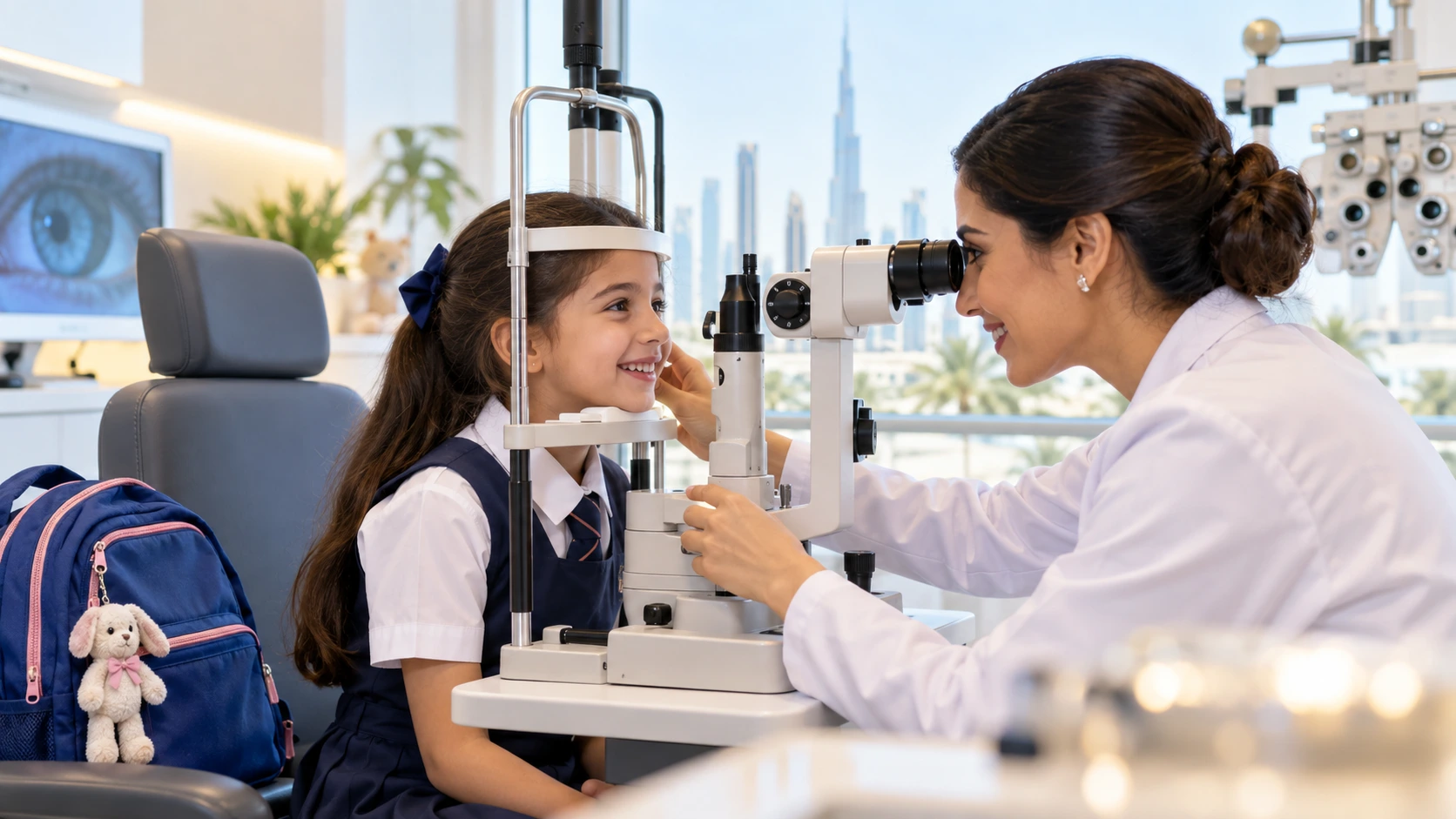
Book an eye test if your child repeatedly squints, cannot see the board clearly, sits very close to screens, gets headaches after schoolwork, rubs the eyes, loses place while reading, covers one eye, or has an eye turn. A full eye exam can identify issues that a simple screening may miss.
See when to book ↓Why back to school is a smart time to check your child’s vision
The school day places constant demands on distance vision, near vision, focusing and eye coordination.
Children rely on clear vision to read, write, see the board, use tablets, play sports and move safely through the school day. When vision is blurry or uncomfortable, the child may work harder just to keep up with ordinary classroom tasks.
A back to school eye test in Dubai can help identify whether your child needs glasses, an updated prescription, lazy-eye assessment, eye-alignment evaluation, myopia monitoring or another form of pediatric eye care.
Important: passing a basic school screening does not always rule out a vision problem. If symptoms continue, a comprehensive eye examination is more appropriate.
- Difficulty seeing the board or distant objects.
- Visual fatigue during reading, homework or screen use.
- Behavior changes such as avoiding reading or losing concentration.
9 signs your child may have a vision problem
Children can adapt to unclear vision without realizing that what they see is not normal. These everyday behaviors are worth watching.
Squinting
Squinting to see the board, TV or distant objects may suggest myopia, astigmatism or another refractive error.
Sitting too close
A child who sits very close to the TV, tablet or book may be trying to compensate for unclear vision.
Headaches after school
Headaches after reading, homework or screen use may be linked to eye strain, uncorrected vision or focusing difficulty.
Eye rubbing
Repeated rubbing can happen with tired eyes, allergies, dry eye or extra visual effort during school tasks.
Reading feels difficult
Losing place, skipping lines, covering one eye or avoiding reading can be a reason to assess the eyes.
Blurred distance vision
Difficulty seeing the board is a common school complaint associated with nearsightedness.
One eye turns
An eye turning inward, outward, upward or downward may indicate strabismus and should be examined.
Covering one eye
Closing or covering one eye may happen with double vision, alignment problems or unequal visual comfort.
Low concentration
Vision problems can make schoolwork tiring and may look like slow reading, low focus or avoiding homework.
School vision screening vs a comprehensive eye exam
A screening can be useful for identifying obvious concerns, but it is not the same as a complete examination. The difference is the depth of assessment.
Vision screening
Often checks whether a child can see letters or symbols at a distance and identifies children who may need further assessment.
Comprehensive eye exam
Can assess prescription, focusing, eye alignment and eye health, with additional testing depending on the child’s needs.
Pediatric eye assessment
Especially relevant when there is an eye turn, lazy-eye concern, headaches, rapid prescription change, family history or school-related visual difficulty.
How poor vision can affect the school day
If vision is blurry or uncomfortable, a child may spend more effort reading, copying from the board or completing homework. This may contribute to visual fatigue, slower reading, headaches or frustration.
Sometimes a child who looks distracted is actually struggling to see. Sometimes a child who avoids reading is experiencing eye strain or uncorrected vision. That is why eye health belongs in the back-to-school checklist.
School tasks that depend on comfortable vision
Common causes of poor vision in children
The right treatment depends on the cause, so repeated or unusual symptoms should be assessed rather than guessed from behavior alone.
Myopia in children: why parents should monitor change
Myopia can progress during childhood. A child may begin with mild nearsightedness and later require stronger glasses, so tracking changes over time is important.
An eye examination can detect myopia and help monitor whether the prescription is changing. If it is progressing, your ophthalmologist may discuss management options and lifestyle guidance based on the child’s age, measurements and risk factors.
For more detail, see Ebsaar’s guide to myopia control in Dubai.
Does screen time cause poor vision?
Screen use is not the only reason children develop vision problems, but long periods of close work can increase visual demand and may worsen symptoms such as dry or tired eyes, headaches and fluctuating vision.
Children using tablets or computers for school should take regular breaks, blink often and use a comfortable working distance. Outdoor activity is also commonly encouraged as part of healthy childhood vision habits.
If your child already has myopia or persistent symptoms, screen habits should not replace regular eye monitoring and professional advice.
What happens during a children’s eye test?
A children’s eye examination is adapted to the child’s age, cooperation, symptoms and medical history. The doctor may use child-friendly methods to check several parts of visual function and eye health.
A back-to-school eye exam may include
When should you book a pediatric eye appointment?
Book an assessment when symptoms repeat, interfere with schoolwork or suggest that vision may not be clear. Some symptoms warrant more prompt attention.
- Your child complains of blurry vision or cannot see the board clearly.
- Your child squints, tilts the head or closes one eye to see.
- Headaches happen after school, reading or screen use.
- One eye turns inward, outward, upward or downward.
- Your child sits too close to screens or holds books very close.
- Reading is slow, uncomfortable or frequently avoided.
- There is a family history of myopia, lazy eye, strabismus or serious eye disease.
- Your child’s glasses prescription appears to be changing quickly.
- There is eye redness, pain, light sensitivity or a sudden change in vision.
Noticing one or more of these signs?
Request a comprehensive children’s eye exam at Ebsaar Eye Surgery Center in Dubai and let an eye-care professional assess the cause.
Back-to-school eye care tips for parents
Children’s eye care at Ebsaar Eye Surgery Center in Dubai
Ebsaar Eye Surgery Center provides specialist ophthalmology care in Dubai, including comprehensive eye examinations, pediatric eye care, lazy-eye assessment, myopia monitoring, dry-eye care, retina care, glaucoma care, cornea care, cataract surgery and vision correction.
For children, the priority is an accurate diagnosis and an examination experience appropriate to the child’s age and needs.
If you are looking for a children’s eye test in Dubai or a pediatric eye doctor in Dubai, you can request an appointment with Ebsaar for an individualized assessment.
Frequently asked questions
Why is a back-to-school eye test important?
It can help detect vision problems that may affect reading, board work, concentration, sports and school confidence. Some children do not complain clearly, so changes in behavior can be an important clue.
Can a child have poor vision even after passing a school screening?
Yes. A basic screening can miss some issues. A comprehensive examination can assess prescription, alignment, focusing, eye health and other concerns.
What are common signs that a child may need glasses?
Squinting, sitting close to screens, holding books very close, headaches, blurred board vision, eye rubbing, slow reading or avoiding homework can all be reasons to book an assessment.
Is myopia common in school-age children?
Myopia is a common reason for blurred distance vision in children and can progress during childhood, so regular monitoring may be recommended.
Can screen use cause eye strain in children?
Long periods of screen use can contribute to tired eyes, dryness, headaches and visual discomfort. Persistent symptoms should be assessed.
Where can I book a children’s eye test in Dubai?
You can request a comprehensive children’s eye examination at Ebsaar Eye Surgery Center in Dubai.